What is laser technology?
Laser applications use a focused beam of energy to weld, cut, clean, braze, or process materials with high accuracy. In automated production, laser technologies help combine speed, precision, and controlled heat input, making it possible to process thin materials and precision components with stable quality and predictable results.
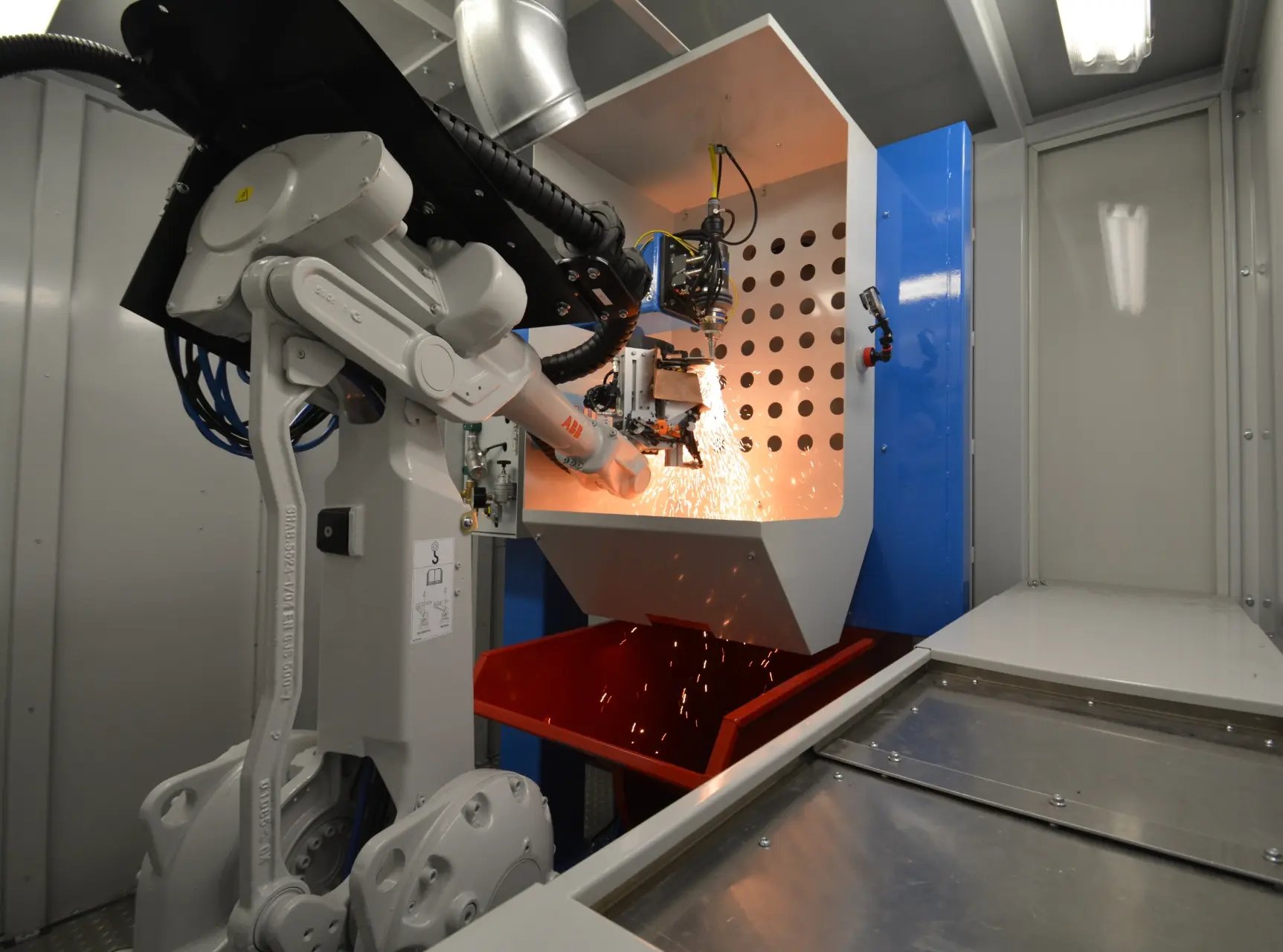
How it works
A high-intensity laser delivers concentrated energy to weld, braze, cut, or process materials with high precision. The process is controlled through accurate positioning, movement, and monitoring, with seam tracking or inspection added when variation in parts or positioning needs to be compensated.
-
Laser welding, hybrid welding, brazing, and cutting.
-
Minimal heat input.
-
Seam tracking and in-line inspection.
.webp?width=1920&height=1261&name=joining-application_laser-welding%20(4).webp)
Laser welding
Besides speed and precision, laser welding offers high productivity, new construction possibilities and cost savings.
.webp?width=1920&height=1278&name=Landingpage_Lasercutting_%20(3).webp)
Laser cutting
The high degree of accuracy, speed, and flexibility of the laser are the great advantages in the use of a laser cutting machine.
Laser cleaning
Laser cleaning is a surface treatment that uses pulsed laser light. Laser cleaning is a friendly cleaning process that does not require any solvents.
_featured.webp?width=1668&height=1125&name=solution_welding%20thin%20sheet%20metal%20(1)_featured.webp)
Welding thin sheet metal
_featured.webp?width=5472&height=3072&name=solutions_welding%20and%20handling%20of%20thin%20metal%20products%20(1)_featured.webp)
Welding and handling of thin metal products
/solutions_Automated%20manufactring%20lines_Flexible%20manufacturing%20of%20cabinets_%20(4)_FeaturedImage.webp?width=1920&height=1080&name=solutions_Automated%20manufactring%20lines_Flexible%20manufacturing%20of%20cabinets_%20(4)_FeaturedImage.webp)
Flexible manufacturing of cabinets
%20(IBC-fencing)/Tarter_USA_%20(13).webp?width=1920&height=1080&name=Tarter_USA_%20(13).webp)
Flexible manufacturing lines
.webp?width=7008&height=4672&name=CustomerExperience_OPS_%20(6).webp)

.webp?width=5474&height=3651&name=CustomerExperience_Tarter_%20(3).webp)

.webp?width=3840&height=2160&name=CustomerExperience_Muhlhoff_%20(2).webp)

.webp?width=4672&height=4000&name=contact_CTA_(5).webp)