What are flexible manufacturing lines?
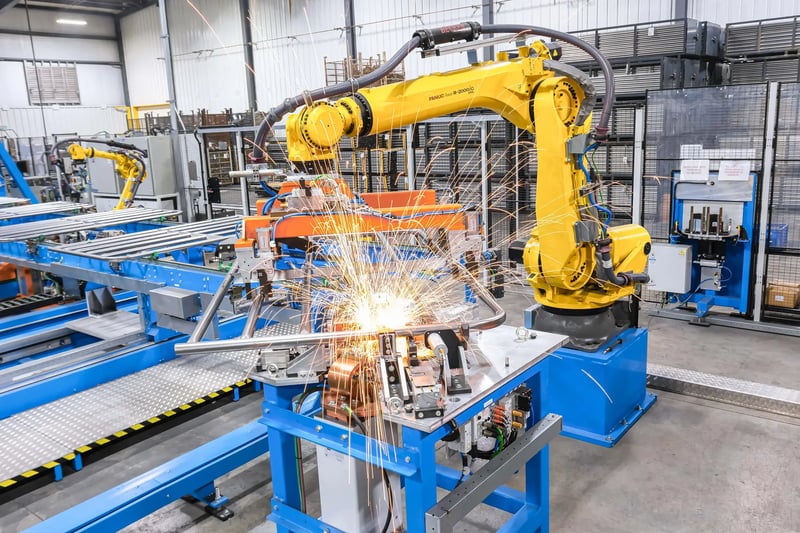
Flexible manufacturing lines combine multiple production processes such as cutting, bending, welding, assembly and material handling into one integrated production system.
Commonly applied in high-volume metal and tube manufacturing, these lines are designed to process different product variants within a single production environment while keeping production flow organized and controlled.
%20(IBC-fencing)/solutions_automated%20manufacturing%20lines_flexible%20manufacturing%20lines%20(3).webp?width=1920&height=1080&name=solutions_automated%20manufacturing%20lines_flexible%20manufacturing%20lines%20(3).webp)
System approach to these challenges
Successful flexible manufacturing depends on how the entire production system is designed. AWL approaches flexible manufacturing as an integrated production system rather than a collection of individual processes. Production flow, product variation and future capacity requirements are considered from the start, creating a scalable line architecture that supports efficient manufacturing across changing volumes and product mixes.
- Integrated production flow.
- Configurable line architecture.
- Designed for product variation.
%20(IBC-fencing)/solutions_automated%20manufacturing%20lines_flexible%20manufacturing%20lines%20(5).webp?width=1920&height=1080&name=solutions_automated%20manufacturing%20lines_flexible%20manufacturing%20lines%20(5).webp)
.webp?width=5474&height=3651&name=CustomerExperience_Tarter_%20(3).webp)

.webp?width=7008&height=4672&name=CustomerExperience_OPS_%20(6).webp)

.webp?width=3840&height=2160&name=CustomerExperience_Muhlhoff_%20(2).webp)

.webp?width=1920&height=1080&name=solutions_Intelligent%20manufacturing%20solutions_AI%20Weld%20Inspection_%20(5).webp)
AI weld inspection
/solutions_Automated%20manufactring%20lines_Flexible%20manufacturing%20of%20cabinets_%20(4)_FeaturedImage.webp?width=1920&height=1080&name=solutions_Automated%20manufactring%20lines_Flexible%20manufacturing%20of%20cabinets_%20(4)_FeaturedImage.webp)
Flexible manufacturing of cabinets
_featured.webp?width=5472&height=3072&name=solutions_welding%20and%20handling%20of%20thin%20metal%20products%20(1)_featured.webp)
Welding and handling of thin metal products
_FeaturedImage.webp?%20Assembly%20cells_ClipnutAssembly_%20(2)_FeaturedImage.webp&width=2497&height=1978&name=Automated%20Joining%20%26%20Assembly%20cells_ClipnutAssembly_%20(2)_FeaturedImage.webp?%20Assembly%20cells_ClipnutAssembly_%20(2)_FeaturedImage.webp)
Clipnut assembly
.webp?width=4672&height=4000&name=contact_CTA_(5).webp)